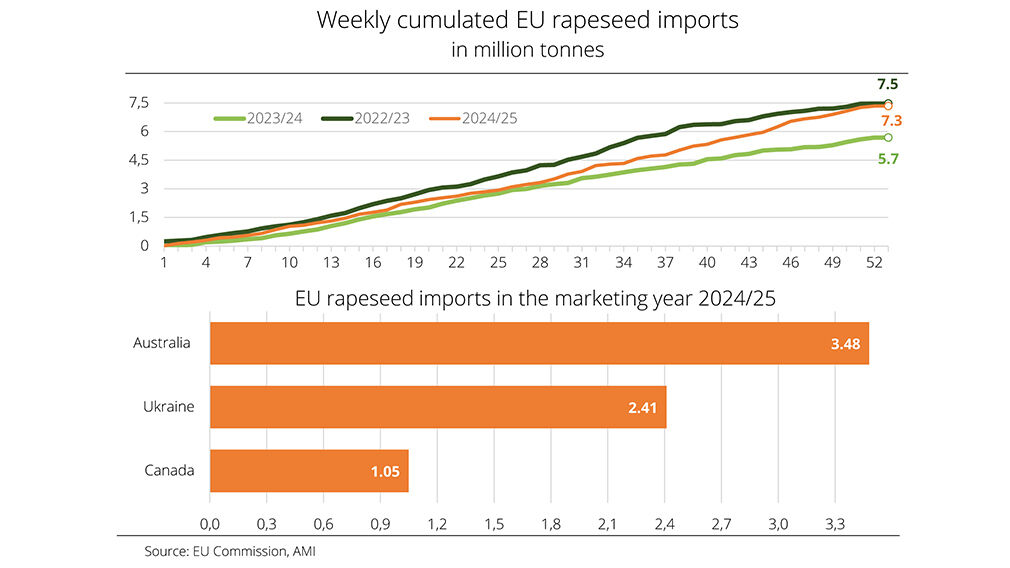
Australia maintained its position as the European Union (EU)’s leading rapeseed supplier in 2024/25, Germany’s Union for the Promotion of Plants and Protein (UFOP) wrote.
Compared to the 2023/24 season, shipments from Australia increased by approximately 86% to 3.5M tonnes, the 17 July report said.
Meanwhile, deliveries from Ukraine dropped by around 24% to 2.4M tonnes.
“This shift towards larger Australian imports was due to the reduced Ukrainian harvest, which amounted to 3.8M tonnes – just under 1M tonnes less than in 2023. This reduction severely limited Ukraine’s export potential,” UFOP said.
With an increase in deliveries from 103,000 tonnes to 1.05M tonnes, Canada also ramped up its shipments.
However, as Canadian farmers produced genetically modified (GM) varieties, the use of rapeseed oil derived from Canadian sources was restricted in the EU and its exports were mainly used for biofuel production, the report said.
According to EU Commission data, EU-27 rapeseed imports from non-EU countries in the period increased from 5.7M tonnes to 7.3M tonnes.
The increase in import demand was mainly driven by a reduction in the EU’s own harvest, UFOP said.
Due to the EU’s continued high level of import demand, UFOP urged rapeseed producers to fully utilise the potential of rapeseed cultivation in planning crop rotation for the 2026 harvest.
“Failing this, the under-supply of oil mills with domestically or EU-grown rapeseed would further accelerate the shift of cultivation areas to non-EU countries such as Australia and Ukraine,” the organisation added.
UFOP said there had been an improvement in the NUTS2/GHG standard values for rapeseed used in biofuel production following their recalculation.