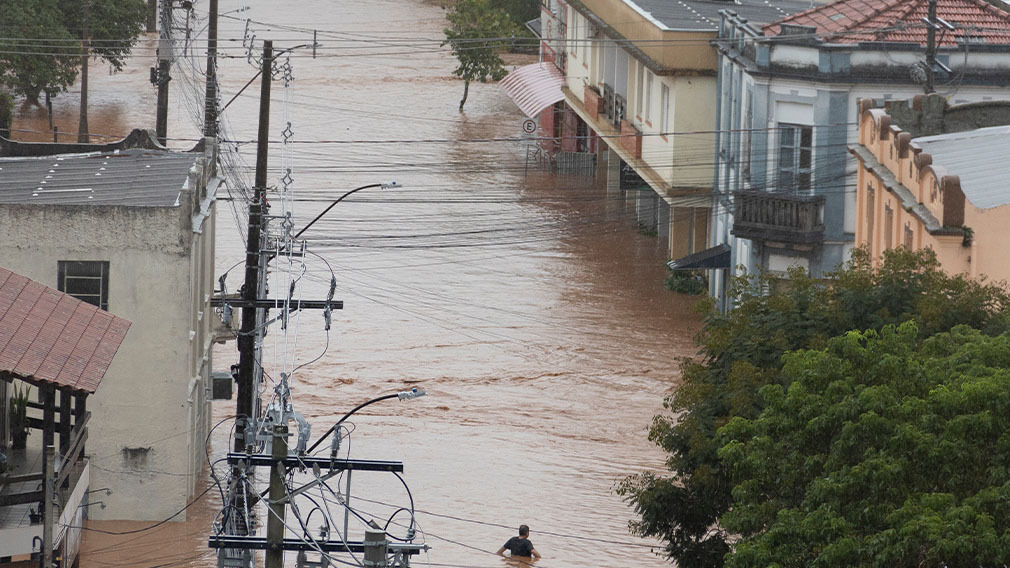
Recent floods in southern Brazil and lower yields across several states have reduced the country’s soyabean production expectations to 150M tonnes in the 2023/24 marketing year, according to a report by the US Department of Agriculture (USDA).
In the USDA’s Foreign Agricultural Service (FAS) report, the FAS reduced its estimate by 2.6M tonnes – or 2% – compared to its March report.
The reduction was mainly due to May’s unprecedented floods in the southernmost state of Rio Grande do Sul in May and lower yields in Mato Grosso, Mato Grosso do Sul, Paraná and São Paulo, the 1 July Global Agricultural Information Network (GAIN) report said.
Revised national yields totalled 3,275 kg/ha (48.7 bushels/acre), 3% lower than the March report, and 10% lower than record productivity in 2022/23.
Against a backdrop of lower soyabean output and solid gross crushing margins, the FAS reduced its export estimates to 94M tonnes, while increasing crushing volumes to 55.1M tonnes in 2023/24 to meet domestic demand.
Crushing volumes are being supported by an increased biofuels blending mandate, attractive gross margins, and Argentina resuming high levels of soyabean crushing and global exports, according to the report.
“This may reduce the incentives for Brazilian crushers to export processed products, particularly soyabean oil, redirecting its supply to domestic consumption,” the FAS said.
The FAS increased its 2024/25 soyabean area forecast by 650,000ha to 46.3M ha, mainly due to an increased 2023/24 baseline area estimate.
If confirmed, the forecast – maintaining a 1% area increase from the previous report – would represent a slowdown in Brazil’s soyabean area expansion as average yearly growth had been at nearly 4% over the last decade.
Production in 2024/25 was forecast at 160M tonnes, up 2.5M tonnes, or 2%, from the previous report.
Despite increased costs, farmers were continuing to invest in quality seeds, inputs and fertilisers to improve yields rather than expanding area, the FAS noted. Yields across the country were forecast at 3,456kg/ha.
The FAS maintained its soyabean exports forecast at 99M tonnes in 2024/25 due to: sustained international demand, mostly from Asia; higher harvested volumes; a favourable exchange rate; and higher competitiveness compared to other producers, such as the USA.
On the demand side, China’s soyabean purchases remained strong, with February-May 2024 imports at 29.5M tonnes. This was close to the 31.5M tonnes recorded during the same period in 2023 when Brazil supplied 70% of the volume (20.6M tonnes) and the USA supplied 26% (7.5M tonnes).