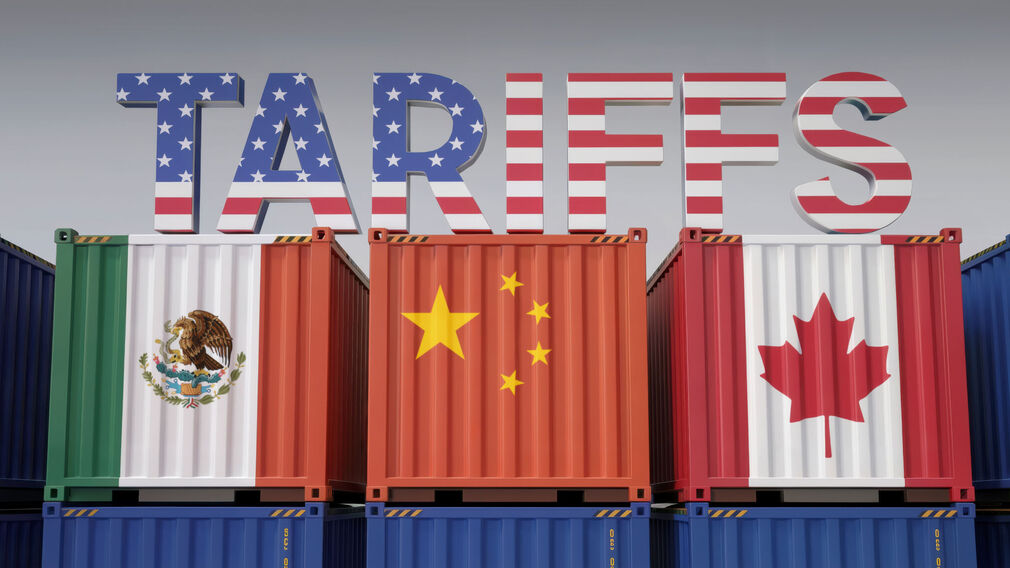
US President Donald Trump’s administration has imposed tariffs on imports from China, Mexico and Canada, causing US stocks to suffer their worst two-day drop since December, the BBC reported on 4 March.
The 25% tariffs on goods from Canada and Mexico - first announced in February - came into force on 4 March, along with a doubling of 10% additional tariffs on China to 20%, sparking retaliation from China and Canada.
Canada retaliated with immediate 25% tariffs against US$30bn worth of US goods, with an additional US$125bn worth of products to be hit over the next 21 days.
China’s counter measures include 15% tariffs on a range of US agricultural and food products, including soyabeans, wheat, corn and beef. The tariffs are estimated to cover US$21bn worth of US agricultural and food products and will take effect on 10 March, although goods already in transit will be exempt until 12 April, according to a 3 March World Grain report.
The Chinese government also announced on 4 March that it had suspended the import licenses of three US companies — farmer-owned cooperative CHS Inc., Louis Dreyfus Co. Grains Merchandising, and EGT, which is partially owned by Bunge Global SA.
The US tariffs on China sit atop existing tariffs on hundreds of billions in Chinese goods, while the only Canadian products exempt from the 25% duties are energy-related items such as crude oil, which will subject to a 10% tax.
China, Mexico and Canada are among the USA’s biggest trading partners, with the three countries making up more than 40% of US imports last year, according to the BBC report.
The Canola Council of Canada (CCC) said in a statement on 4 March that the US measure would have “widespread, devastating impacts” on the country’s canola industry.
“The US decision to go forward with 25% tariffs on Canadian-grown canola and canola products will be felt across the canola value chain, with devastating impacts on farmers, input providers, canola crushing activities and exports of canola seed, oil and meal,” CCC president and CEO Chris Davison said.
The USA is Canada’s leading market for canola exports and a market that is well integrated with the Canadian canola industry, according to the CCC.
The total export value of Canadian canola products to the USA in 2023 was C$8.6bn (US$5.8bn), including almost 3M tonnes of canola oil valued at C$6.3bn (US$4.3bn) and more than 3.5M tonnes of canola meal valued at C$2bn (US$1.4bn).
Canola is the single largest contributor to farm crop cash receipts – grown by nearly 40,000 farmers across the country, the CCC said.
“The damaging blow caused by tariffs will be felt by every canola farmer, starting with the price they receive at delivery and will extend to the full range of their operations, ultimately reducing farm profitability,” Rick White, president and CEO of the Canadian Canola Growers Association (CCGA).
Davison and White said the canola industry delivered a “true win-win for both Canada and the USA” and they would do all they could to restore “smooth, predictable, tariff-free canola trade” between the two countries.
China’s foreign ministry spokesman Lin Jian said trying to exert maximum pressure on China was “a miscalculation and a mistake”, CNN Business reported on 4 March.
“If the USA... persists in waging a tariff war, a trade war, or any other kind of war, the Chinese side will fight them to the bitter end.”
The Chinese suspension of the import licenses of CHS, Louis Dreyfus and EGT were due to the detection of ergot as well as seed-coating agents in soyabeans exported to China, China’s customs department said in a statement to Reuters on 5 March.
Trump has claimed the tariffs would grow the US economy, protect jobs and increase income from taxes, the BBC wrote.
However, some industry sources said higher taxes on imports could push up the price of goods in the USA.
According to Harry Murphy Cruise, head of China economics at Moody’s Analytics, if the tariffs lingered, Chinese exports to the USA could drop by a quarter to a third.
“The tariffs are broadly negative for US agricultural markets. It is going to have a bearish influence on prices. There are enough corn and soyabean supplies in the world for China to make a switch, it is more of an issue for the USA, because 30% of US soyabeans still go to China,” Ole Houe, of Ikon commodities, told Reuters.
Mexican President Claudia Sheinbaum said the USA’s decision to continue with tariffs on Mexico came “despite our work against gangs and fentanyl”, the BBC reported.
At the time of the BBC report, no retaliatory measures had been announced by Mexico, and while Sheinbaum said Mexico would impose “tariff and non-tariff measures”, she did not give any details.
Further details would be announced on 9th March when they would be announced in a public speech, she said.