


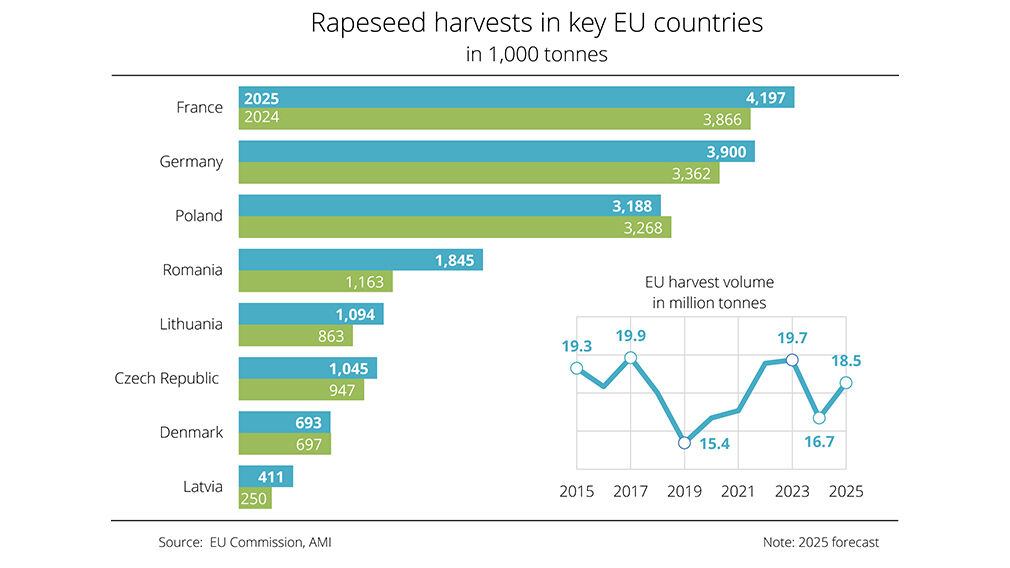
The European Union (EU) will harvest approximately 18.5M tonnes of rapeseed in 2025, according to the latest European Commission (EC) data reported by Germany’s Union for the Promotion of Plants and Protein (UFOP).
Although this would be 385,000 tonnes below the June estimate, it would be an increase of almost 1.9M tonnes compared to the 2024 harvest when poor weather had severely limited yield potential and would also exceed the long-term average of 17.8M tonnes, the 31 July report said.
However, the increased output would not meet the EU-27’s demand of approximately 25M tonnes, UFOP said.
Previous forecasts by the International Grains Council (IGC) and the US Department of Agriculture (USDA) were slightly more optimistic, at 18.8M tonnes and 19.5M tonnes, respectively.
The year-on-year increase was mainly due to an anticipated larger harvest in France, the EU’s largest rapeseed producer.
At the time of the report, the EC – along with the French agricultural statistical office Agreste – projected French rapeseed production at 4.2M tonnes.
Although this was slightly lower than the June estimate, it was still well above last year’s 3.9M tonnes.
The month of June was unprecedentedly hot with record-breaking temperatures and a significant precipitation deficit, particularly in mid-western France.
Despite these conditions, the impact on winter crops was generally limited, as they had already entered or even completed their maturing phase, the report said.
The finer weather also allowed for an earlier-than-usual start to harvest operations.
At just over 1.8M tonnes, Romania’s rapeseed production forecast was also revised downward, but the EC expected an increase of 682,000 tonnes compared to the previous year.
The forecast for Germany remained unchanged at 3.9M tonnes, a significant rise from 3.6M tonnes the previous year.
According to research by Agrarmarkt Informations-Gesellschaft, the EC’s forecast slightly exceeds the latest estimate from the Deutscher Raiffeisenverband (German Raiffeisen Association), which is approximately 17,000 tonnes lower.
In Germany, the progress of harvest operations had been slow due to delays caused by recurrent wet conditions in many regions, the report said.
At the time of the report, unsettled weather conditions were expected to continue, allowing only short harvest windows.
Despite these challenges, there had already been positive reports regarding yields and oil content, the report said.
