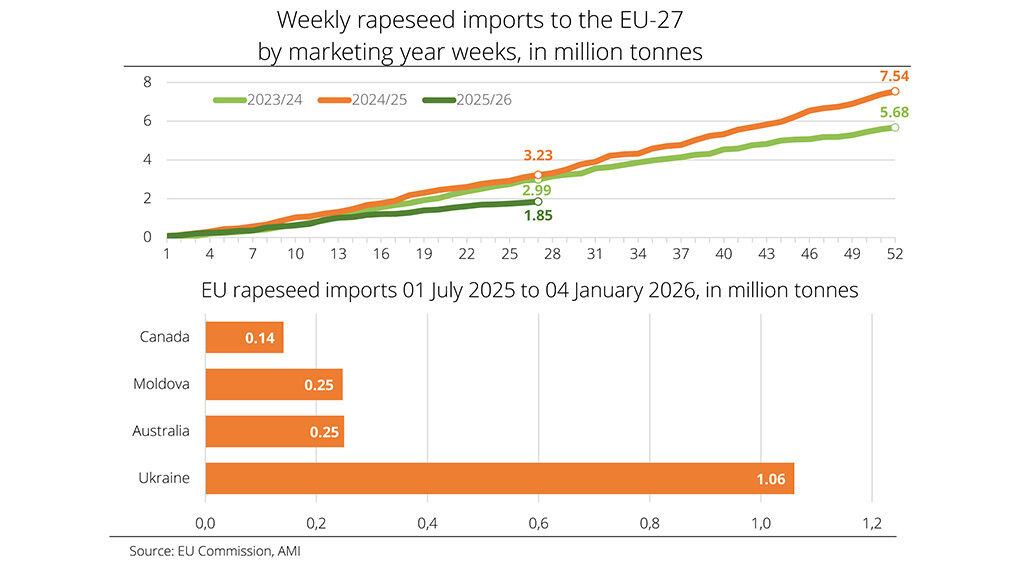
European Union (EU) rapeseed imports declined in 2025 due to increased supplies of the oilseed in the bloc, Germany’s Union for the Promotion of Plants and Protein (UFOP) wrote.
According to European Commission (EC) estimates, last year’s EU-27 rapeseed totalled around 20.16M tonnes, a significant increase compared to the 2024 volume of 16.77M tonnes.
With rapeseed processing expected to reach around 24.68M tonnes, it also reduced the EU’s dependence on imports, the 15 January report said.
Total imports into the EU-27 in the first half of the 2025/26 crop year totalled approximately 1.85M tonnes, an almost 43% decline from the previous year’s level of 3.23M tonnes.
With shipments just over 1.06M tonnes to date and a 57% share of imports, Ukraine remains the EU’s leading supplier, according to the report.
Despite this, the country’s shipments remained below the previous year’s volume of 2.02M tonnes.
By January, Australia had shipped 249,869 tonnes of rapeseed to the EU, ranking second among the major countries of origin with a share of just under 14% although well behind Ukraine.
According to research by Agrarmarkt Informations-Gesellschaft, deliveries remained approximately 71% below the previous year’s levels.
However, the second wave of imports from Australia will increasingly come into focus later in the season, according to the report.
Canada continued to lose market share, with the country delivering 140,915 tonnes of rapeseed to date, compared to 161,347 tonnes the previous year.
As Canadian farmers grew genetically modified (GM) varieties, the use of rapeseed oil derived from the country’s rapeseed was restricted in the EU and primarily used for biofuel production.
Moldova and Serbia ramped up their deliveries significantly compared to the first half of the 2024/25 crop year, supplying 247,357 tonnes and 114,171 tonnes respectively, compared to 85,611 tonnes and 44,501 tonnes the previous year.
Some rapeseed imports declared as Moldovan were likely to be of Ukrainian origin, due to changes in transit and trade routes, according to the report.