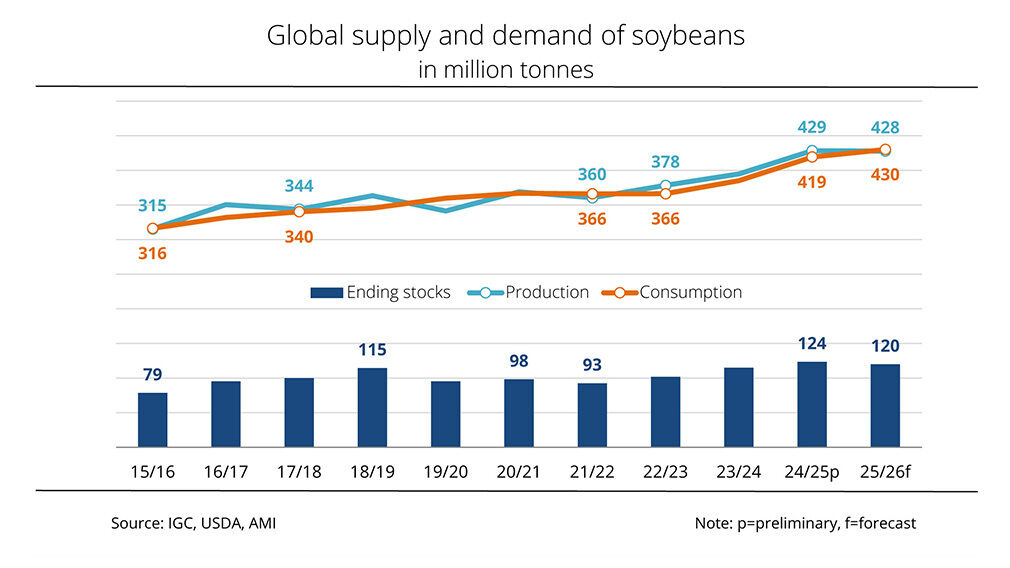
Worldwide soyabean consumption is set to reach a new record of about 430M tonnes, according to International Grain Council (IGC) estimates reported by Germany’s Union for the Promotion of Plants and Protein (UFOP).
The growth in consumption was driven by rising demand for meat and, consequently, high-protein animal feed, particularly in Asia’s rapidly expanding food production sector, the 31 October report said.
Despite good harvests, supply on the global soyabean market remains tight and consumption is growing faster than production, causing stocks to decline for the first time in several years, according to the report.
At the same time, the shift in world trade towards South America was becoming increasingly strong.
The IGC estimated global soyabean production in 2025/26 at 428M tonnes.
At an estimated 116M tonnes, the US harvest was expected to remain around 3% below the previous season’s level due to poor weather conditions and delayed harvest operations.
A record crop was forecast in Brazil, which strengthened its position as the world’s leading supplier. Production was projected to rise to 177M tonnes, equivalent to a planted area of approximately 47M ha – about four times the size of Germany’s cropland area.
However, Argentina was expected to see a slight decline in soyabean output to 48.5M tonnes, due to many farmers switching to maize and sunflower production.
The international soyabean trade remains dynamic, according to the report.
The IGC estimated total global trade at 187M tonnes, a year-on-year increase of approximately 3M tonnes.
Brazil was expected to account for the largest share, with exports reaching 113M tonnes, further consolidating its position as the world’s leading supplier.
China remained the most important consumer, with imports totalling 113M tonnes, sourced almost exclusively from South America.
The USA continued to lose market share, with exports falling around 10% to 45M tonnes, mainly due to the US government’s trade policy and the resulting drop in Chinese purchases, the report said.
According to research by Agrarmarkt Informations-Gesellschaft, global ending stocks were projected at 120M tonnes, a decline of around 3.5M tonnes compared to the previous season.
Stocks in South America were particularly low due to extensive late-season export activity.