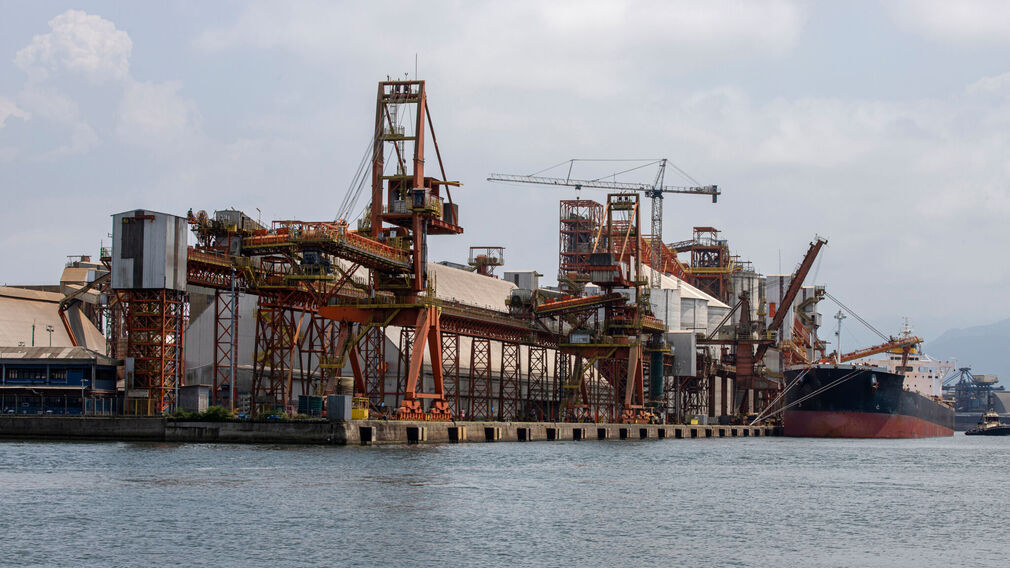
Brazilian rail operator Rumo SA has cancelled the sale of its 50% stake in a grain terminal at Brazil's Port of Santos, to Bunge Global and Zen-Noh Group, according to a securities filing by the company reported by World Grain.
When first announcing the deal last May, Rumo said the agreement was valued at BRL600M (US$107.8M).
Speaking about the cancelled sale, Rumo said certain conditions for the sale of its equity interest in Terminal XXXIX “were not fully satisfied” before the established deadline. No further details were disclosed in the 5 June filing.
The deal would have been delivered through a joint venture between US-based Bunge and Zen-Noh Grain Corp, the US subsidiary of Japan’s Zen-Noh Group, with each of the partners holding an equal stake, the 10 June report said.
Terminal XXXIX at Port of Santos, South America’s largest port, has the capacity to store 135,000 tonnes of grain. Brazilian food and fuel processor Caramuru Alimentos, one of the country’s largest grain crushers, holds the remaining 50% of the terminal, World Grain wrote on 30 May.
“Rumo reaffirms its commitment to the optimisation of its assets portfolio and capital structure and will continue to assess opportunities that are aligned with its business strategy,” the company was quoted as saying.
Located on São Paulo state’s coastline, the Port of Santos acts as a key export hub for Brazilian soyabeans and is the largest in Latin America, connecting more than 600 ports in 125 countries. It is also the most important foreign trade route in Brazil, with almost 27% of the country’s trade balance (US$112.3bn) passing through the port, according to Santos Port Authority.
According to its website, Rumo operates approximately 14,000km of railway lines with direct connection to the ports of Santos, Paranaguá, São Francisco do Sul and Rio Grande, from where most of the country’s grain production is exported.
According to Brazilian ship brokers Cargo Chartering, Rumo operates several terminals at the Port of Santos, including the T-GRÃO terminal at Wharf 26, which is specifically designed for the storage and shipment of soyabeans and maize. This terminal has a storage capacity of 114,000 tonnes and can handle up to 15,000 tonnes/day, with a loading rate of 1,000 tonnes/hour.
With 1,400 locomotives and 35,000 railway wagons, the company transports 26% of the grain volume exported by Brazil. Products transported by the company include fertilisers, corn, wheat, soyabeans, bran, vegetable oil and sugar.