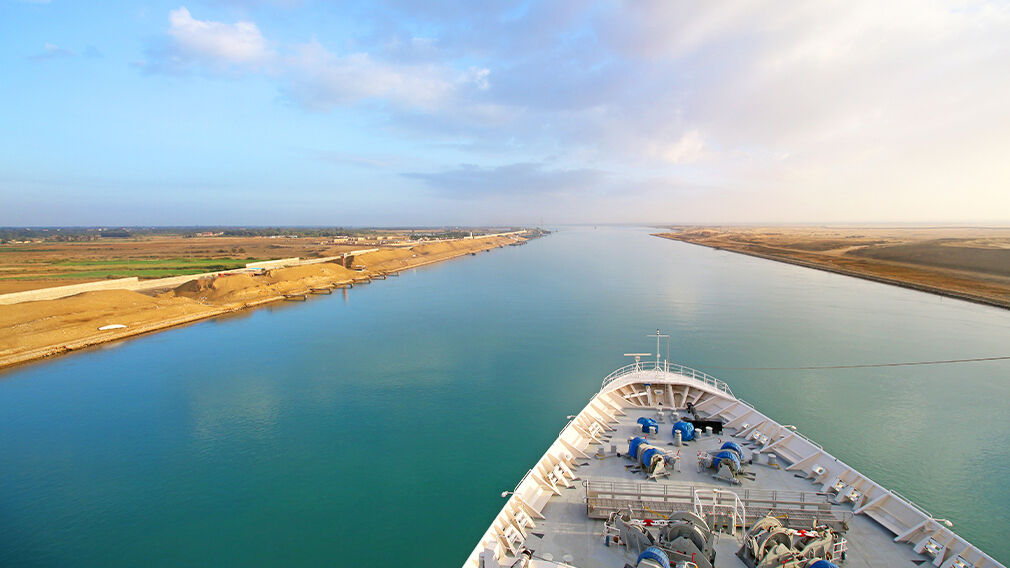
Shipping companies have begun reintroducing services through the Suez Canal, according to a Riverside Tanker Chartering report.
The return of some services followed an announcement by the Houthis on 25 November confirming their ceasefire on commercial shipping after two years of attacks, the February ‘Palm, Soft oil and Molasses’ market report said.
Houthi attacks on vessels plying the Red Sea had caused major disruption to global trade, including oilseed and vegetable oil shipments.
Following Israel’s Gaza military campaign in October 2023, the Yemen-based Iranian-backed militants launched missile and drone attacks in November 2023 on merchant ships in the Red Sea in support of Palestinians.
Any ship passing through the Suez Canal – the quickest sea route between Asia and Europe – has to travel via the Strait of Bab el-Mandeb and the Red Sea.
As a result of the Red Sea attacks, several of the world’s largest shipping firms (including Maersk and Hapag-Lloyd) suspended shipping through the Suez Canal – which handled about 12% of global trade – and were re-routing around Africa’s Cape of Good Hope, a diversion that could take 10-14 days longer and was more costly.
According to World Trade Organization (WTO) data, total grain and oilseed volumes transiting via the Suez Canal fell from 7.2M tonnes in November 2023 to 5.9M tonnes the following month – nearly a fifth down on an annual basis and 15% below the three-year average.
Following the Houthis’ latest announcement on 15 January, AP Moller-Maersk said it would be relaunching its first full liner service passing through the Suez Canal.
Solely operated by Maersk, the MECL Service connects the Middle East and India with the US East Coast.
The move followed the successful trans-Suez transits of the ‘Maersk Sebarok’ and the ‘Maersk Denver’.
On 3 February, AP Moller-Maersk and Hapag-Lloyd announced that, following comprehensive security assessments, they had also decided to adjust the routing of one of their shared services under the Gemini Cooperation, the report said.
From mid-February, the IMX Service, connecting India and the Middle East with the Mediterranean, was scheduled to transit through the Red Sea and the Suez Canal. The changes would involve westbound sailings of the ‘Albert Maersk,’ and eastbound sailings of ‘Astrid Maersk’. All passages would be secured by naval assistance, Riverside Tanker Chartering wrote.
Oils and fats are mainly transported by sea in specialised tanker ships with stainless steel or coated tanks.
For smaller shipments, Maersk offers a Flexibag Logistics service for transporting bulk liquid cargo, including oils and fats such as olive, palm and fish oils.
The packaging method involves placing US Food and Drug Administration (FDA)-approved flexibags, made from multiple layers of polyethylene and polypropylene, inside containers.
The company’s flexibag-equipped containers can hold up to 24,000 litres of liquid.