


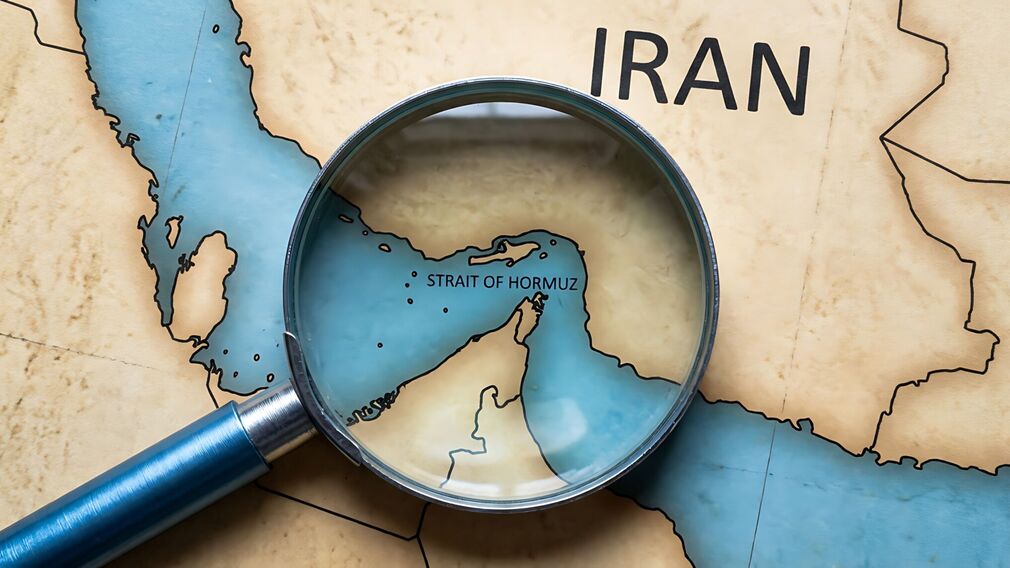
Transit through the Strait of Hormuz could take weeks to rebuild and navigation would only restart once safety was guaranteed, after the USA and Iran agreed a deal to reopen the waterway, Reuters quoted shippers in Asia and Europe as saying.
At the time of the 15 June report, US and Iranian officials were expected to sign a memorandum of understanding (MoU) to end their war and reopen the strait on Friday 19 June.
Following the announcement of the agreement, global oil prices fell by about 5%, Reuters wrote.
According to a 15 June FreightWaves report, the USA would lift its blockade of the strait, through which 20% of the world’s crude oil supply flows, within 30 days of the agreement.
In a Truth Social post on 15 June, President Donald Trump said ships loaded with oil were starting to move out of the strait.
However, no significant tanker crossings were visible in vessel-tracking data that day, apart from one LNG carrier, although ships had been moving barrels along Oman’s coast for week with US navy support, Reuters wrote.
The data, which captures only vessels actively transmitting their positions, showed dozens of tankers clustered on both sides of the strait.
While welcoming news of the deal, shippers said they were waiting for more details, including information on mine clearance.
“The shipping companies probably want to wait until it is clear that the agreement holds, as we have already had Hormuz ‘open’ for a very short time twice before,” Haider Anjum, a Jyske Bank analyst, was quoted as saying.
Shipping association BIMCO said it still considered transit through the strait highly risky, with mines a key concern.
“The next step is for shipowners to be reassured that transiting the Strait of Hormuz is not only permitted, but also safe,” BIMCO’s chief safety and security officer Jakob Larsen said.
Danish shipping giant Maersk welcomed the agreement but also said it was too early to assess its impact and that it was making no changes yet to its Middle East operations.
German shipowners’ association VDR said it was “cautiously optimistic” if the deal could reopen the strait, while shipper Hapag-Lloyd said it hoped vessels would soon be able to cross it.
The Norwegian Shipowners’ Association said details of the agreement and the framework for any transit remained unclear, as did the extent of mines laid in key shipping lanes.
As of 15 June, an estimated 155 tankers, carrying oil and chemicals, were in the Gulf area, ship-tracking data from Kpler showed, down from 201 at the end of May.
Under unrestricted navigation, the traffic pile-up on either side could be resolved in eight to 10 days, Anoop Singh, global head of shipping research at Oil Brokerage said.
According to David Jorbenaze, global oil market leader at ICIS, for meaningful traffic to resume it would require weeks of de-mining and normalisation of insurance rates.
“Returning to full pre-conflict volumes is realistically a 2027 story, and only if the agreement holds without incident and production recovers at pace,” he added.
Under unrestricted navigation, the traffic pile-up on either side could be resolved in eight to 10 days, Anoop Singh, global head of shipping research at Oil Brokerage said.
