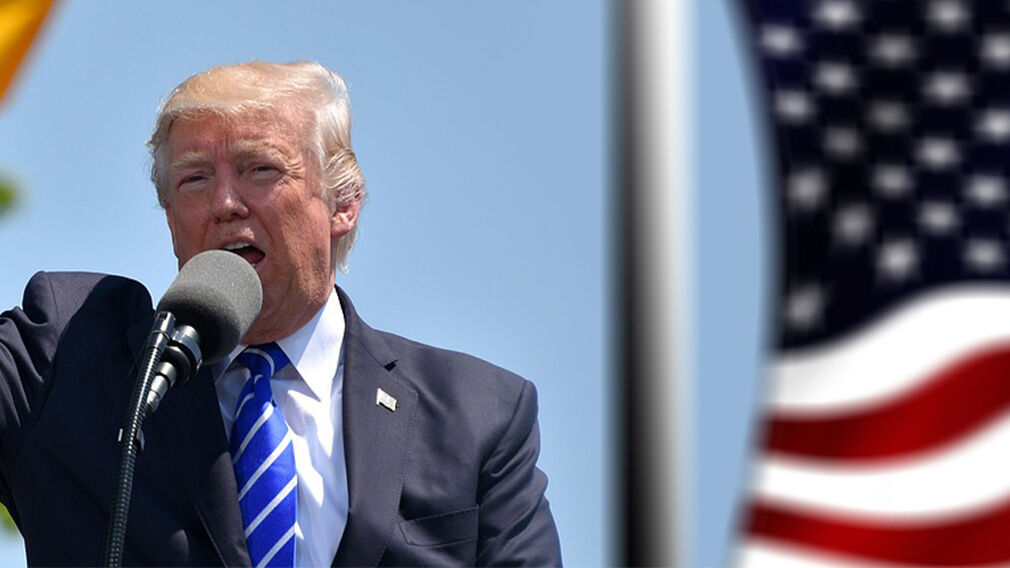
US President Donald Trump has issued an order calling for a review of US trade relationships with Canada, China and Mexico, World Grain reported.
Although Trump did not impose tariffs on trade partners on the first day of his second term in office as he had said he would do, he did threaten new 25% tariffs on imports from Canada and Mexico by 1 February, the 22 January report said.
Following Trump’s tariff threats, Canada vowed a strong response, while Mexico urged ‘calm’, FreightWaves reported on 23 January.
Canadian Prime Minister Justin Trudeau was quoted as saying that while he was prepared to launch counter-tariffs if Trump introduced 25% on goods from Canada, he would rather work with the USA to avoid a trade war, FreightWaves wrote.
However, other Canadian officials saw a trade war between the two nations as inevitable, the report said.
Mexican President Claudia Sheinbaum was quoted as saying that officials needed to keep “cool heads” in response to Trump’s tariff threats.
She also said tariffs would violate the United States-Mexico-Canada Agreement trade pact that was signed by Trump in 2020.
Officials in China had not directly addressed Trump’s new tariff threats but said there were “no winners” in a global trade war, the report said.
During his first term as president, Trump imposed tariffs on thousands of China-made products, FreightWaves wrote.
In response, China imposed retaliatory tariffs on many US exports, including a wide range of agricultural and food products.
According to the FreightWaves report, Trump is now threatening to impose an additional 10% tariff on all Chinese goods entering the USA.
Tariffs on China could have significant implications for the US soyabean industry, which relies heavily on exports to China.
Trump was also considering tariffs against the EU, saying the bloc was not importing enough US goods.
European Commission President Ursula von der Leyen was quoted as saying that Europe was ready to “protect our interests”.
A number of options were open to Trump to introduce tariffs, World Grain quoted Mario A Torrico, an associate attorney for the law firm ArentFox Schiff, as saying on 19 January, the day before Trump’s inauguration.
“There is a statutory authority – IEPA – that has never been used, but in recent reporting Trump has said he wants to use that authority,” Torrico said. “And under IEPA he could implement tariffs very fast.”
IEPA is the International Emergency Powers Act and, to implement it, the president would have to declare a national emergency.
Other tools available to the president included section 301, which involves tariffs on countries that are in violation of fair-trade practices, according to Torrico. President Trump used section 301 during his first term to impose some tariffs on China. There is also section 232, which allows the president to impose tariffs on specific goods.
If Trump used section 232, it would trigger an investigation by the Department of Commerce to make specific findings. The whole process would take up to 270 days before tariffs could be implemented.
“301 is a little different,” Torrico said. “You have to allow the US Trade Representative to make findings as to an unfair trade practice. I would say it would take six months.”
Looking at all the possibilities open to Trump following his inauguration, Torrico said he thought there would be a “waiting phase to see how countries react”.
Overall, Torrico said much of the discussion about the imposition of tariffs was a negotiating tactic and what ultimately happened would depend on the response of the governments of Canada, China, Mexico and any other country that was threatened.
Regarding the US-Mexico-Canada Agreement, Torrico said this could be reviewed and revised in 2026, and Trump wanted to renegotiate the agreement.