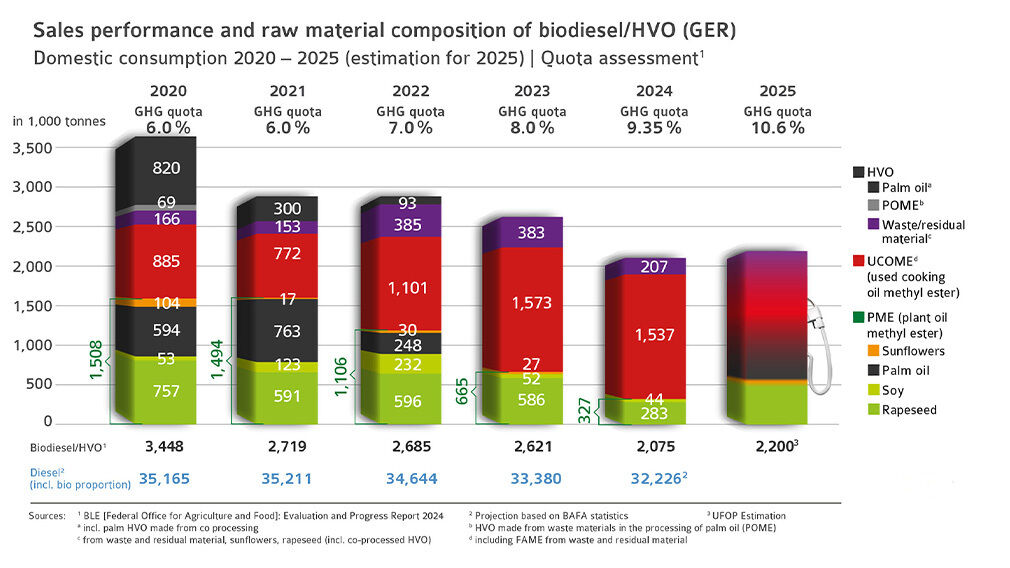
The abolition of advanced biofuels ‘double counting’ in a draft bill approved by the German Federal Cabinet has been welcomed by Germany’s Union for the Promotion of Plants and Protein (UFOP).
UFOP said the move – along with the requirement for on-site inspections – would help prevent fraud.
The draft bill was adopted by the Cabinet on 12 December and transposes the requirements of the EU’s revised European Renewable Energy Directive (RED III), introducing significant changes, according to a report by German law firm Gleiss Lutz.
Double counting of advanced biofuels towards greenhouse gas (GHG) reduction quotas would be eliminated starting in the 2026 compliance year, although this would not apply to fuels already placed on the market before 1 January 2026, the report said.
Eliminating double counting was seen as a vital step in deterring fraud and driving physical demand for biofuels, and recent cases of mislabelled biofuels had highlighted the urgency of this action, according to the report.
“It remains to be seen whether the planned anti-fraud measures – particularly the discontinuation of double counting and the introduction of new control instruments – will, in fact, prove effective in eliminating false incentives and restoring the demand for sustainably-produced biofuels,” Gleiss Lutz wrote.
In addition to the elimination of double counting, the draft law also proposes that if an on-site inspection confirmed a suspicion of fraud, or if confirmation of an audit was not provided, a biofuel could not count towards GHG quota obligations, UFOP said on 28 January.
Although the Federal Cabinet had formally adopted the draft bill, it would still need to
be passed by the German Parliament (Bundestag) and the Federal Council of Germany (Bundesrat) before becoming law.
“The stricter requirements will prompt companies in the mineral oil industry that are subject to quotas to scrutinise their sources of supply even more closely than before,” UFOP said.