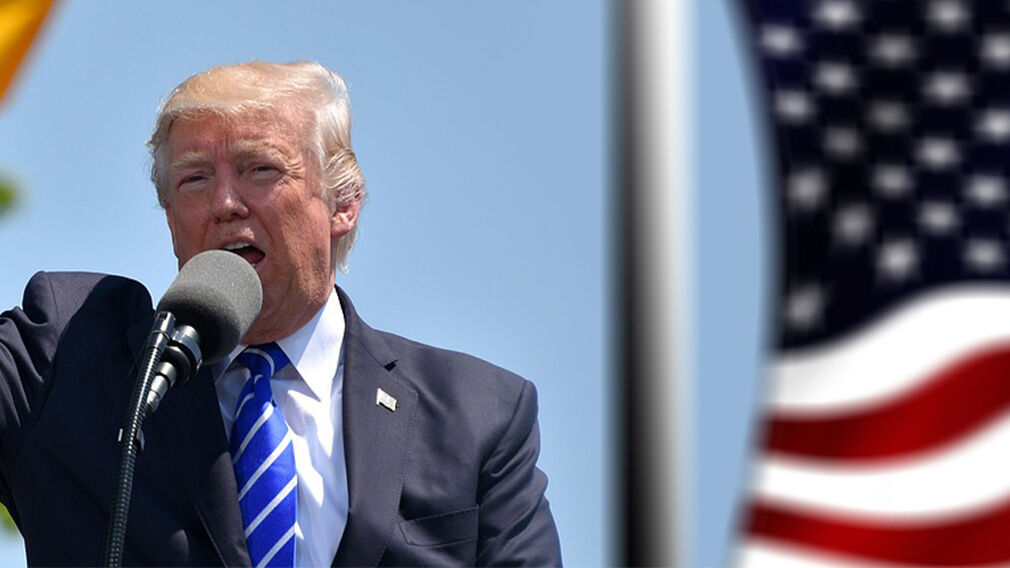
The USA has started collecting a temporary new 10% tariff on imports from all countries following a US Supreme Court ruling to strike down sweeping global levies introduced by US President Donald Trump last year.
The Trump administration was also working to increase the 10% rate to 15%, Reuters quoted a White House official as saying.
On 20 February, the Supreme Court ruled that Trump had exceeded his authority and should have got congressional approval for the tariffs he introduced last year under the International Emergency Economic Powers Act (IEEPA).
The same day, Trump ordered an immediate 10% flat rate tariff on all imports – in addition to any existing levies - and then raised the levy to 15% on 21 February.
However, late on 23 February, the US Customs and Border Protection (CBP) agency notified shippers that the rate would be 10% and Trump had not signed a formal presidential order for the increase to 15%, the 24 February Reuters report said.
The White House official told Reuters that Trump had had “no change of heart” in his desire for a 15% tariff but offered no details on the timing for that increase.
Some products would be exempt from the new temporary tariffs including US-Mexico-Canada Agreement (USMCA)-compliant goods from Canada and Mexico.
The new tariffs have been introduced under section 122 of the Trade Act of 1974 – which had never previously been used – allowing the president to impose a levy for 150 days, The Guardian wrote on 21 February. After the 150-day period, the administration would have to seek congressional approval.
Although the Supreme Court’s decision was welcomed by US agriculture and food industry stakeholders, they conceded that it might not significantly change the trajectory of the global trade war, World Grain wrote on 24 February.
For example, soyabean producers and traders had seen a 13% drop in exports in 2025 compared with the previous year, the report said.
Although China, by far its largest customer, had agreed to begin importing US soyabeans in late 2025 after months of not taking in shipments from what has typically been its largest supplier, it had been a fraction of its typical annual intake, World Grain wrote.
Soyabean farmers have also been severely impacted by the rising costs of key imported products needed for soyabean production, according to the report.
“The case at the Supreme Court has been closely followed by soyabean farmers who have seen the cost of inputs rise over the past year due to tariffs,” Scott Metzger, president of the American Soybean Association (ASA) was quoted as saying.
“US soyabean growers are reliant upon imports for critical farming tools like fertiliser, seeds, pesticides and agriculture equipment. Moving forward, certainty and dependable market access are essential for US soya to remain competitive globally.”
In a 22 February report, the Financial Times (FT) wrote that Trump’s new global tariffs would be a boost for China and Brazil.
US trade representative Jamieson Greer was quoted as saying that the new global tariffs would not affect Trump’s upcoming meeting with Chinese President Xi Jinping.
The purpose of the bilateral meeting was “to maintain stability, make sure that the Chinese are holding up their end of our deal and buying American agricultural products” and Boeing jets, and “sending us the rare earths that we need”, he added.
On 23 February, the BBC reported that China said it was “conducting a comprehensive assessment of [the] content and impact” of the ruling.
“China has consistently opposed all forms of unilateral tariff increases and has repeatedly emphasised that there are no winners in a trade war, and protectionism leads nowhere,” a Ministry of Commerce spokesperson was quoted as saying.
Beijing had committed to buying at least 25M tonnes/year of US soyabeans to 2028, a figure announced by the White House under a trade deal between the two countries in October, the South China Morning Post (SCMP) reported on 4 February.
Malaysia – which signed a trade deal with the USA in October - may need to revisit its agreement, according to a 21 February New Straits Times (NST) report. Revisiting the deal may include seeking legal advice, particularly on how to negotiate should the outcome adversely affect Malaysia, the report said.
The trade pact exempted 1,711 Malaysian export product lines from tariffs when entering the US market, NST wrote.
Malaysia was now closely monitoring legal and policy developments in the USA, The Star quoted the Investment, Trade and Industry Minister Johari Ghani as saying in a 21 February report.
“At this stage, we are awaiting further clarity on how these measures will be implemented and whether additional adjustments will follow,” he said.
In the week before the Supreme Court’s decision, Indonesia and the USA had also finalised an agreement to lower US tariffs on the Southeast Asian country to 19% from 32%, while securing tariff exemptions for palm oil, coffee and cocoa, the BBC reported on 20 February.
Indonesia was ready to face all possibilities and would now monitor developments, Indonesian President Prabowo Subianto said in a 22 February Reuters report.
Indonesia’s chief negotiator for US tariffs, Airlangga Hartarto, also said
that the trade deal agreed on 20 February was still in force as there would be different treatment for countries that had signed a trade agreement with Washington.
The deal was signed after months of negotiations, with palm oil a particularly important exemption, accounting for around 9% of Indonesia’s overall exports, Reuters wrote on 20 February.
In return, Indonesia would remove tariff barriers on most US products across all sectors and address a range of non-tariff barriers such as local content requirements, according to a White House fact sheet.
According to latest government data, the USA had already collected at least US$130bn in tariffs using the IEEPA.